

The Next Now Reimagining Retail for an Agentic, AI-Driven Future
Executive Summary
NRF 2026 showed a shift in retail’s approach to AI, moving from complete automation to disciplined, infrastructure-driven change. Retailers now prioritise practical AI applications that deliver value and are building the foundations for sustainable progress.
A key development at NRF was the step-change in agentic commerce and the introduction of the Universal Commerce Protocol (UCP). UCP does not directly create new shopping experiences. Instead, it standardises how core commerce actions such as checkout, payment, fulfilment, and consent are executed by AI agents securely and consistently, while retailers retain control as the merchant of record.
This is crucial now, as platform capabilities, customer behaviour and commerce infrastructure are rapidly changing. AI interfaces are advancing from discovery to execution, and integration costs and risks have decreased significantly. However, poor data quality, fragmented systems, and weak operating models remain major challenges.
UCP is not the answer to agentic commerce, but it is a real enabler. Retailers who move quickly and invest in clean data, unified commerce foundations, and strong governance will be best positioned to engage in AI-enabled commerce on their own terms. Those who wait risk adapting on terms set by platforms rather than by design.
Introduction: From Noise to Signals
NRF has always been a cornerstone for the future of retail. In 2026, however, the most important developments were not the flashy demos or bold claims we are used to seeing. Across sessions and side conversations, the emphasis was noticeably more restrained. The focus shifted to structural changes that will shape how retail operates over the next five to ten years.
Growth remains difficult, and the continued expansion of channels has added material complexity and cost. Retailers are focusing on incremental gains instead of pursuing every new trend.
NRF 2026 showed the industry recalibrating. Retailers are now pinpointing where AI delivers real value, where it falls short, and what foundational changes are required for long-term progress.
Key Themes from NRF 2026
1. From AI Everywhere to Agents Everywhere
AI was prominent at NRF 2026, but the emphasis shifted toward practical, low risk use cases that reduce friction in daily retail operations. Reporting, customer segmentation, product information management, and planning workflows received particular attention.
Retailers are increasingly comfortable using AI to reduce manual effort and support decision-making. Where AI is delivering value today is in discovery, insight generation, and productivity rather than full autonomy. This reflects broader industry findings. McKinsey reports that AI currently delivers the strongest returns in decision support and workflow automation, rather than fully autonomous decision-making, reinforcing the shift toward practical, assistive use cases (McKinsey, 2025).
2. Unified Commerce as the Starting Point
Unified commerce is now a baseline expectation rather than an aspirational goal. Retailers emphasised the need for a single commerce engine to consistently manage pricing, inventory, fulfilment, and payments across all channels. Fragmented channel logic is no longer seen as a growth constraint, but as a structural liability. This aligns with analyst perspectives that unified commerce architectures are now a prerequisite for applying AI at scale, rather than a downstream optimisation (McKinsey, 2024).
3. Data foundations as the enabler
Separately, a clear message emerged around data foundations. AI does not fail because models are immature, but because the data beneath them is fragmented. Gartner consistently identifies poor data quality as one of the leading barriers to successful AI deployment across industries. Without a consistent, trusted source of truth, even advanced AI capabilities produce unreliable or misleading outcomes.
4. Cointelligence: AI-Assisted Selling
Artificial intelligence is becoming more common in retail, but the National Retail Federation advises that it should remain largely invisible to customers. As one retailer noted, AI should be “everywhere but visible nowhere.” Its primary purpose is to improve sales processes while preserving the essential human connection in retail. Research from the Capgemini Research Institute shows that 74% of consumers still prefer human interaction during in-store service, and this preference is growing. Therefore, the most effective use of AI is to support retail associates with analysis and recommendations, enabling them to focus on judgment, empathy, and trust rather than routine tasks.
5. Agentic Commerce and the Emergence of UCP
A major announcement at NRF was the introduction of the Universal Commerce Protocol (UCP), a shared standard supported by leading retailers and platforms to define how AI agents interact with commerce systems. UCP does not create agentic commerce but enables standardisation at scale. Unlike bespoke solutions, UCP defines how commerce actions, checkout, fulfilment, discounts, and consent are executed consistently across AI agents and platforms, facilitating seamless adoption by retailers and partners.
6. In-Store Experiences Still Matter
Retail media continues to expand, but the focus is shifting from monetisation to measurement and accountability, particularly in physical stores where many retail transactions still occur across many categories. Perennial in-store digital technologies like shelf-edge labels, dynamic signage, and immersive displays continue their slow evolution. The current challenge is demonstrating value and linking exposure to outcomes, rather than just adding more screens. Retailers now see the in-store experience as a core part of their media strategy, not a separate channel.
7. Trust, Privacy, and the Human Factor
As automation grows, human interaction is becoming more valuable. Customers are becoming more comfortable using AI for discovery and decision support, but remain selective about delegating control, particularly for high-consideration purchases. This shift has increased focus on privacy, identity, and consent. Personalisation must now be earned, not assumed. Many discussions reinforced that in an automated world, human interaction is a premium experience rather than a cost to eliminate.
8. Sustainability: From Ideology to Economics
Sustainability at NRF 2026 was framed less as an ideological commitment and more as a commercial imperative. Retailers focused on how sustainability initiatives drive tangible outcomes, including waste reduction, inventory efficiency, and supply chain resilience. The prevailing view was clear: sustainability programs are now expected to deliver measurable financial returns, with inaction increasingly viewed as a source of margin pressure and long-term earnings risk.
Deep Dive: Agentic Commerce and the Universal Commerce Protocol (UCP)
What Is Agentic Commerce? What Existed Before?
Agentic commerce refers to AI systems that act on a customer’s behalf to complete commerce tasks end-to-end, from discovery and selection to checkout, payment, and post-purchase actions. Historically, AI in retail has been largely assistive, supporting search, recommendations, and content creation rather than completing transactions.
What is changing is the volume of intent now flowing through AI-mediated interfaces. Gartner estimates that 25% of search volume will move to AI assistants by 2026, signalling a structural shift in how customers discover and engage with retailers. This change is less about ranking and more about participation. Retailers that are not machine-readable and transactable risk being excluded from AI-driven consideration altogether.
Earlier attempts at agent-driven shopping were limited and fragile, relying on bespoke integrations, platform-controlled checkouts, or manual handoffs. These approaches were costly to maintain, difficult to scale, and often required retailers to surrender control, keeping agentic commerce largely confined to pilots rather than real-world deployment.
What is the Universal Commerce Protocol (UCP), and how does it work?
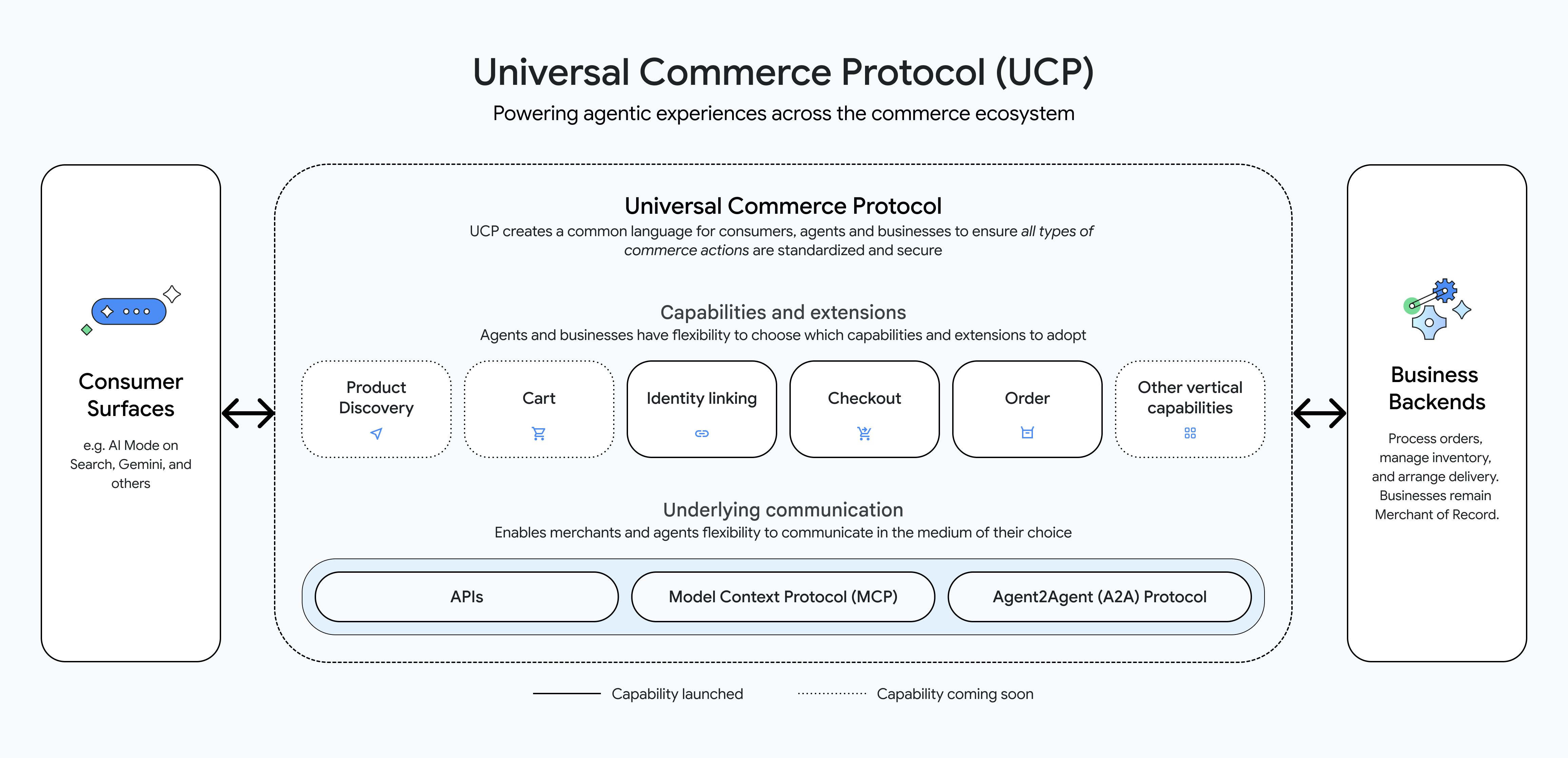
The Universal Commerce Protocol (UCP) is an open-source standard that defines how commerce systems interact with AI agents. UCP establishes a common, secure language that connects AI agents with retailer systems across the entire shopping journey, from discovery through purchase and post-purchase support. It defines the capabilities that enable an AI system to conduct commerce, such as inventory checks, cart actions, checkout initiation, payment authorisation, and buyer consent.
This lets retailers communicate with different AI platforms without custom integrations for each agent-merchant combination.
At a high level, here is how it works:
Standardised commerce capabilities: Retailers expose a defined set of commerce actions, such as availability, pricing, cart operations, checkout, and fulfilment, in a consistent format that any compliant agent can call.
Separation of discovery and execution: Product discovery and catalogue information remain outside the protocol, handled through existing mechanisms such as feeds and shopping graphs, while UCP governs the execution layer once a purchase decision is made.
Interoperability: Agents do not require unique integrations for every retailer or platform. Any system that supports UCP can interoperate with any UCP-aware agent.
Secure, auditable flows: UCP supports secure delegation and payment authorisation so transactions can be completed with verifiable consent and consistent handling of business rules.
This standard enables new commerce channels, such as conversational and in-context checkout, while ensuring retailers maintain control over pricing, policies, customer relationships, and compliance.
What UCP Solves and What It Doesn’t.
UCP uniquely addresses the fragmentation that has historically made agentic commerce impractical. Its singular value lies in providing a shared, open standard that eliminates the need for retailer-specific integrations, directly reducing costs, complexity, and fragility—capabilities not offered by earlier approaches.
It also makes agent-initiated transactions more viable by enabling secure execution, verified consent, and auditable handling of business rules.
What UCP Does Not Do
What UCP does not do is fix underlying retail foundations. It does not resolve poor product data, inaccurate inventory, fragmented systems, or weak operating models, nor does it remove retailer accountability for pricing, fulfilment, or customer experience.
In summary, UCP reduces structural friction, but its value depends on the retailer’s foundational systems.
Why UCP Matters Now
UCP is important now because customer behaviour, platform capabilities, and commerce infrastructure are evolving simultaneously. These changes affect where transactions occur, how they are executed, and the costs for retailers to participate.
Customer behaviour is moving upstream.
Consumers are increasingly comfortable delegating intent, not just searching. Conversational interfaces are becoming the starting point for discovery and decision-making. Retailers who stay current remain visible to AI systems, while those who do not risk exclusion. For example, a retailer not adopting UCP may find their products missing from AI agent suggestions, resulting in lost purchasing decisions. This is a participation issue, not just a ranking issue.
Platforms are moving from assist to execute.
AI platforms now support checkout, payment, and post-purchase actions directly within their interfaces, marking a structural shift in commerce. Retailers who focus only on optimising websites and apps risk missing new transaction channels. UCP enables taking part in these channels while preserving retailer control over pricing, policies, and customer relationships. As Google noted at NRF, AI is increasingly moving beyond recommendation toward direct execution across the shopping journey.
The cost and risk of integration have dropped materially.
Historically, preparing for agent-driven commerce required custom integrations, platform-specific logic, and ongoing maintenance. UCP replaces this with a shared standard, reducing integration complexity, engineering effort, and fragility. This lowers both cost and operational risk, making UCP a practical foundation.
Operational efficiency improves as a by-product.
Standardised execution improves operational efficiency. Retailers no longer need to rebuild commerce logic for each new channel, reducing overhead and preventing growing complexity.
The Risk of Doing Nothing
The risk of delay is not only missing opportunities but also being forced into reactive integrations under time pressure and losing influence over how AI agents represent products.
Over time, this can shift customer relationships to platforms by default rather than by retailer intent. Early action creates options, while late action creates dependency.
Risks, Watchouts, and Gotchas
While UCP reduces many structural barriers, disciplined execution remains essential. Retailers should consider numerous functional factors.
Data quality remains a gating factor
UCP relies on accurate, structured, and timely data exposed through API-driven integrations. Poor product data, inconsistent pricing logic, or unreliable inventory will surface faster and at greater scale when execution is automated, leaving little room for manual correction.
Operational issues become visible sooner
Agent-initiated transactions occur immediately. Issues previously managed manually, such as stock inaccuracies or fulfilment exceptions, are now visible directly to customers.
Governance must be in place before exposure
Clear rules for agent actions, along with audit trails, consent management, and kill switches, are needed. Without these, risks shift from technical failure to legal and reputational exposure.
Not all use cases are appropriate on day one
Retailers should be selective about which products, journeys, and scenarios to enable. High-consideration purchases or complex fulfilment may require tighter controls or phased adoption.
UCP is an enabler, not a strategy
Adopting the protocol without a clear operating model, ownership, or roadmap risks building capability without delivering value.
Consideration and Customer Support Remain Open Questions
UCP is effective for straightforward transactions with clear intent and explicit rules. However, many retail journeys are complex, and high consideration purchases often require comparison, reassurance, and human support.
UCP does not specify how advice, exception handling, or post-purchase service should function when AI agents initiate transactions, nor does it address the quality of customer support from AI platforms. As a result, agentic commerce will likely develop first in lower-risk, repeatable scenarios, while more complex journeys will depend on hybrid models that combine AI with human oversight.
How Retailers Can Become UCP-Ready
Becoming UCP-ready is less about adopting new AI tools and more about establishing the right foundations. Retailers do not need to deploy agent-driven experiences immediately, but must have modular, governed, and reliable commerce capabilities.
Readiness spans three areas: technology, people, and operating model.
Technology Foundations
Retailers need commerce systems that provide core capabilities as services rather than hard-coded flows. This includes product data, pricing, inventory, checkout, payments, fulfilment, and post-purchase actions that are accessible programmatically and operate consistently across channels.
Data quality is equally important. AI systems depend on structured, accurate information. Inconsistent product attributes, outdated inventory, or fragmented pricing logic undermine automation efforts and readiness for UCP.
People and Capability
UCP readiness requires clear ownership across technology, digital, and operations teams. Retailers need skills to define business rules, manage exceptions, and govern automation.
This is not about hiring large AI teams, but about aligning existing roles around data stewardship, commerce architecture, and decision accountability as automation increases.
Process and Operating Model
As execution becomes more automated, processes must be explicit. Rules for promotions, substitutions, returns, and fulfilment should be clearly defined and applied consistently.
Strong governance is essential. Retailers must audit agent actions, manage consent, and intervene when necessary. Automation increases speed, but accountability does not change.
Practical UCP Readiness Checklist
1. Clean Product and Merchandising Data
AI systems require structured, accurate product information to assess suitability. Clear attributes, variants, bundles, pricing, and availability are essential for reliable discovery and execution.
2. Modular Checkout and Payments
Checkout and payment flows should function as reusable services, not tightly coupled experiences. This enables AI agents to initiate transactions while retailers retain control over the customer experience and merchant-of-record responsibilities.
3. Explicit Business Rules
AI cannot infer intent or rely on informal knowledge. Rules for discounts, substitutions, returns, eligibility, and fulfilment must be clearly defined and machine-interpretable to prevent errors and exceptions.
4. Secure Identity and Buyer Consent
Retailers must verify that a customer has authorised an agent to act on their behalf. This requires secure identity handling, consent capture, and auditability of agent-initiated actions.
5. Inventory Accuracy and Fulfilment Visibility
Agent-driven transactions occur immediately. Inventory availability must be reliable and visible at the fulfilment node to prevent cancellations, substitutions, and customer dissatisfaction.
6. Post-Purchase Digital Support
UCP readiness goes beyond checkout. Retailers need programmatic support for order tracking, changes, cancellations, returns, and refunds so agents can manage the entire order lifecycle.
7. Governance, Controls, and Accountability
Automation increases speed, not accountability. Retailers need logging, monitoring, safety mechanisms such as throttling or kill switches, and clear ownership for outcomes when AI acts.
How Mulberry Helps Retailers Prepare
Preparing for agentic commerce is not a single technology decision. It requires coordinated progress across data, platforms, operating models, and governance. Mulberry supports retailers at every stage, helping them move proactively rather than reactively.
UCP Readiness Assessment
We assess how prepared a retailer’s architecture, data, and operations are for agentic commerce. This process identifies gaps, risks, and actions to strengthen foundations, regardless of when agent-driven experiences are deployed.
Retailer Workshops and Road Mapping
Through focused workshops, we help retailers turn emerging ideas into practical decisions. This approach aligns technology, digital, and operations teams around clear priorities and a realistic path forward.
Technology, People, and Operating Model Alignment
Agentic commerce changes how work is done. We help retailers align platforms, skills, governance, and accountability to introduce automation safely and effectively.
Conclusion
NRF 2026 marked a turning point. Retail is moving toward disciplined, infrastructure-led change instead of unchecked automation.
Agentic commerce and UCP are not complete solutions, but they are important enablers. Retailers who invest in fundamentals now will be best positioned as AI-driven commerce matures.
Author
Isaac Davis is a Consulting Intern at Mulberry Group, working across retail strategy, commerce transformation, and emerging AI-enabled operating models.
________________________________________
References
BCG (2025) Agentic commerce: Redefining retail and how to respond. Boston Consulting Group. Available at: https://www.bcg.com/publications/2025/agentic-commerce-redefining-retail-how-to-respond
Google Developers Blog (2025). Under the hood: Universal Commerce Protocol (UCP). Available at: https://developers.googleblog.com/under-the-hood-universal-commerce-protocol-ucp/
McKinsey & Company (2025). The agentic commerce opportunity: How AI agents are ushering in a new era for consumers and merchants. Available at: https://www.mckinsey.com/capabilities/quantumblack/our-insights/the-agentic-commerce-opportunity-how-ai-agents-are-ushering-in-a-new-era-for-consumers-and-merchants
Salesmate (2025) Universal Commerce Protocol (UCP): What it is and why it matters. Available at: https://www.salesmate.io/blog/universal-commerce-protocol/
Shopify Engineering (2025) Universal Commerce Protocol (UCP). Available at: https://shopify.engineering/ucp
UCP.dev (2025) Universal Commerce Protocol. Available at: https://ucp.dev/
Gartner (2024) Predicts 2026: Search and Discovery. Gartner Research.

